Press release and link below:
You Can’t Get There From Here
Curated by Evan Mirapaul
Featuring work by:
Stephen Berkman, Marco Citron,
Jan Dziaczkowski and Joanna Rajkowska
September 10 – October 30, 2010
Opening reception: Friday, September 10, 6 – 8pm
CCNY is proud to present You Can’t Get There From Here, an exhibition of four contemporary photographers who challenge our perceptions of time and place. The world as depicted by these photographers may seem familiar and real, but is, in fact, constructed or deliberately out of synch with our expectations. These artists, using a variety of techniques such as collage, antiquarian processes, and color shifts, create a visual reality that seems tangible and real, but is inaccessible to us in every way except our imaginations. Upon closer examination certain elements in these pictures are jarring or anachronistic, forcing viewers to reconsider their preconceptions about each scene, and, by extension, assumptions about how we see the world. You Can’t Get There From Here, is the fourth in a series of guest-curated exhibitions at CCNY.
Stephen Berkman’s work is rooted in another age. As he says, “My objective is to make my photographic works as timely and as relevant to the 19th century as I possibly can. ” Indeed, his portraits seem to be the lost work of a time-traveling tintype or Daguerrotype maker, one who brings his anachronistic modern aesthetic to an antique process. Like many artists in this exhibit, Berkman views history as a plastic and malleable concept.
Jan Dziaczkowski (pronounced: jotch-kov-skee) imagines a different history for Western Europe. What if the Iron Curtain had extended through the UK? How would Western European capitals look if the socialist architecture of the Cold War had taken root across Europe? Jan Dziaczkowski uses period postcards as base material that he collages into cityscapes that look realistic and familiar. These postcards come from a European vacation that didn’t happen, but is easily imaginable.
Marco Citron is also inspired by postcards, notably the Martin Parr collection titled Boring Postcards. Mr. Citron seeks out locations and vantage points in Eastern Europe that seem to have never moved beyond the 1950s or 60s aesthetic, which he then photographs in that period’s flat postcard style. Artificial coloring is added to heighten the effect of a place suspended in time. Though we could actually visit these places (they are the only photographs in the show that present an unaltered contemporary landscape), Citron’s perspective places them firmly in another era, one unavailable to us photographically, politically, and physically.
In her series Postcards From Switzerland, Joanna Rajkowska (pronounced: rye-kov-ska) uses Photoshop to combine two wildly disparate urban environments. Uniting images from public spaces in Bern, Switzerland with images from places of conflict in the Middle East, the surprise is not how different these places look, but how unnoticeable many of the additions are. The artist says, “Israeli checkpoints and blockades fit almost imperceptibly into a ‘Western European cityscape’. ” Despite how far away and foreign the armed hotspots of the world may seem to us, Ms. Rajkowska shows us how quickly and easily they could be made a part of our own familiar terrain.
Gallery hours: Monday – Saturday 12 - 6 pm
CCNY‘s guest–curated exhibitions are supported, in part, by public funds from the New York City Department of Cultural Affairs, in partnership with the City Council.
CCNY is celebrating over 125 years serving the photographic and art community through this and upcoming exhibitions, lectures, and special events. For more information, contact John Stanley at info@cameraclubny.org or by phone at 212–260–9927.
Friday, September 3, 2010


Friday, May 7, 2010
China redux
Is it possible to tell the difference between Fugitive Vision silence because of my laziness and silence because of internet control? I hope so, because I'm about to leave a period of the former and re-enter a period of the latter. I hope this next 2 week period of silence will not be tallied in the laziness column.
I've just spent the last 2 weeks in Germany and have much to report. I started off at the Berlin Gallery Weekend where, in addition to dozens of gallery openings, I had the pleasure to visit a number of public collections including the inauguration of the Olbricht Collection, the Sammlung Hoffmann, the Düsseldorf School focused de Ganay Collection, Daimler-Chrysler Collection, and Sammlung Roosen-Trinks. All of this will be reported on at a later date.
The reason for the enforced silence is that I am returning to China. As I mentioned a few posts ago, I will be a judge in the Shanghai International Photo Competition starting next week. If my trip last December is any guide, I will not have access to this blog while I'm on mainland China. I have no doubt there will be much to tell once I return from radio silence.
This trip was supposed to be: Berlin, Bratislava, Vienna, Frankfurt, and Shanghai. However, I did a VERY stupid thing. I forgot to get my Chinese visa before I left for Germany. Stupid, right? How could I forget this? The fact has really trashed my last week. I just got my passport back today from the visa expediter I use in NYC. I was without it for a week. Hence I didn't go to Bratislava to do the studio visits I had planned, and I didn't go to Vienna to participate in Vienna Fair with my gallery friends. Bummed. But I have the passport and the visa now, so at least the China portion of the trip has been salvaged. Sigh. It all cost me a bundle plus I really lost out by not going to Vienna and Slovakia.I ended up spending the week in Frankfurt with a day trip to Köln. Köln was especially satisfying including a visit to Schaden Books, Priska Pasquer Gallery, and Kolumba Museum. Reports on all of this and more when I get back. There are even some artist discoveries to make up for the lost Slovakian opportunities (Bratislava artist reviews WILL come at a later date).
Wednesday, April 28, 2010
Houston Fotofest
I spent the week of March 22 in Houston as a reviewer for Fotofest. This was my second time at the festival but my first as an official participant. The first time I went, I was bowled over by the abundance of art Houston offered me. Museum of Fine Art Houston, The Menil (which includes the Rothko Chapel and the Twombly Gallery), Houston Center for Photography, not to mention dozens of galleries are all worth a trip by themselves, and we haven't even started to mention the program that Fotofest puts together. Make no mistake, Houston is an art lover's destination.
The Menil Collection is an idyll for an art lover. I was smitten the first time I went, and time hasn't dulled my infatuation. Renzo Piano's building is an oasis for art, and the Menil fills it with examples from antiquity to contemporary that satisfy any thirst. It's my luck that every day I've visited has been a perfect spring day. Ambling along Michael Heizer's land sculpture in the front lawn, gazing at Mark di Suvero's sculpture from a bench under blossoming cherry trees, or simply marveling at how Piano's architecture seamlessly blends with the neighborhood, the experience comes close to perfection. Maurizio Cattelan was a guest curator for the installation that was up while I was there interweaving his own works into the holdings of the collection with wit and intelligence.
Anne Wilkes Tucker has few peers in the photographic museum community. In Houston at the MFA, she has built one of the great collections of photography in the American museum canon. I've had the pleasure of meeting her in a number of cities around the world where I've benefited from her quiet and generous pedagogical spirit, so it's a special treat to be on her home court. I won't labor the details of the exhibit I saw this time, I only mention that this, too, is a Houston treasure worth a special visit.
But the reason we all trek down to Houston every two years is Fotofest itself. And the soul of Fotofest is the portfolio review. Four full-on weeks of them. Hundreds of photographers and dozens upon dozens of reviewers. The sheer quantity of work being looked at boggles the mind. In addition to the official review sessions, photographers roam the lobby of the hotel asking for extra sessions. I'd been warned before I went the first time that I should choose carefully which bathroom to use because one might be asked to look at work mid-stream, so to speak. I wasn't accosted like that, but there many requests for extra time. I figure that's the reason I'm there, so I usually say yes, but it's an exhausting schedule even without the extras. The size of the event, in a funny way, is one of the few disappointments of the festival. Unless you attend the full four weeks, there's no telling what interesting artist you missed in a previous or succeeding week. But that's a quibble. There's plenty of visual nourishment in any given week. Fotofest also mounts exhibitions. They usually contain a mix of established and less seen artists. The lesser known artists are either younger or are from places less well-served by a gallery scene. I count these introductions as highly as the ones I make at the reviewer tables. The following recommendations are a combination of work I saw in the exhibits and work I saw at the official review sessions.
Portfolio review is a funny animal. Both artist and reviewer come to the table with expectations and assumptions. Some of these are reasonable and helpful, and others are....well....something else. I'll leave it to a future post to air my (highly subjective) thoughts on review sessions, but suffice it to say I heard about some mind-boggling behavior from both sides of the equation. My philosophy about reviews is that the artist has paid a fee and deserves something back for that fee. Unless the artist specifically asks my opinion about the work, I usually restrict my comments to practical suggestions for career advancement and professional opportunities. That is what most of the artists have paid their fees to receive. Of course, it goes without saying that there's work which speaks to me more personally that others. Below you'll find a list of the work I found most satisfying - both in the reviews and in the shows - with a short description and a website. My apologies to those of you whom I met and are not listed. This is a highly edited and personal list which excludes much very fine work.
Houston Center for Photography had a solo show for Anthony Goicolea. Mr. Goicolea needs no introduction from me, but I wanted to mention him for two reasons. The first reason is that I have underestimated him. I was completely unimpressed with the early series that chronicled teenage boys in metaphorical tableaux, but subsequently I have been won over. The last 2 shows at Postmasters Gallery have been spectacular and unassailable. The second reason is that the HCP show was also a marvel. In particular, the diptychs from the "Related" series are masterpieces. From the artist's website: Goicolea has executed a series of portraits based on old photographs of family members, known and unknown, while they were still living in Cuba. By drawing and painting these portraits, Goicolea creates a reinterpreted, second-generation reproduction of their likenesses. These images are drawn to resemble daguerreotypes and are executed in negative on layered Mylar and glass. After drawing his own negatives, Goicolea then inverts them to create a positive photographic mirror of each drawing.
This is an artist to follow. I am a convert. If you haven't already, check him out. he's the real deal.
Matthew Brandt was included in one of the Fotofest shows highlighting young artists from Southern California. I was impressed by his integrated use of substances taken from the subject of his photograph (lake water, body fluids) and antiquarian processes. http://www.matthewbrandt.com/
Myra Greene has a gorgeously realized and completed project of ambrotype self-portraits that explore the representation of cultural stereotypes in 19th century photo objects. Super. http://www.myragreene.com/
Jason Lazarus and Richard Mosse were part of a Fotofest show, "Whatever Was Splendid: New American Photographs". Mr. Lazarus' use of fictionalized narratives paired with found photos blown up to epic size were new (at least to me) and very effective. Mr. Mosse had eerily beautiful portraits of car carcasses demolished by warfare in Iraq in addition to a terrifying video which united wounded American vets playing violent video games at Walter Reade with video game-like footage of actual airstrikes. Not to be missed. http://www.richardmosse.com/, http://jasonlazarus.com/
Andrew Buurman was showing a fine series highlighting people in positions of worship and devotion while gazing at schedule boards in transit hubs. He's also the creator of a fine book called "Allotments" which is available on Amazon. http://www.buurman.co.uk/
Greta Pratt has a CV which would lead you to believe she's better known than she is. A solo show at the Smithsonian including a catalog, a solo show at MassMoCA, and a Steidl book to count just a few high points. She has a number of finely developed projects -- my favorite is Lincoln portraits -- that are ripe picking for a smart gallery. Collectors take note, too. Prints are available and are inexplicably undersold. http://www.gretapratt.com/
Erika Diettes is a sensitive yet unsentimental Colombian artist who was showing powerful work about the Disappeared Ones from Colombia's drug wars. Ms Diettes understood that many bodies were disposed of in lakes and rivers, so frequently the only way family knew of the loved one's death was when an article of clothing washed ashore. In her "Rio Abajo" series she photographed pieces of the found clothing submerged in water, then mounted the photo to a body-sized glass panel which is suspended from the ceiling. Simple and powerful. In some ways it's reminiscent of that other important Colombian artist, Oscar Muñoz (a link she happily admits), but the work stands easily apart and for itself. http://www.erikadiettes.com/
Amy Eckert brought some small, intellectually engaging collages which discussed architecture and our ideas of home. They combine magazine images with her own photographs in a way that left me completely convinced. I plan to buy. http://www.amyeckertphoto.com/
David Rochkind had a compelling documentary series about the effect of the drug trade on rural Mexican cities. By his own admission it's a wok in progress, but worth a look for fans of tough, clear-eyed documentary work. http://www.davidrochkind.com/
Dennis Yermoshin showed an autobiographical/documentary series about his immigrant Azerbaijani family which was solid and compelling. He's young and maybe a tad unseasoned, but he's super talented and one to watch. http://www.yermoshin.com/
I saw Chris Sims' work as a juror for Critical Mass last year. I reviewed it highly there, and I continue to be impressed. The series he showed me here was about faux Iraqi villages built on US Army bases to "acclimate" soldiers to life in a middle eastern combat zone. If they weren't terrifyingly surreal they'd be funny. http://www.chrissimsprojects.com/#/selected-work
I'm in Germany now. Posts from Berlin's Gallery Weekend coming soon.
The Menil Collection is an idyll for an art lover. I was smitten the first time I went, and time hasn't dulled my infatuation. Renzo Piano's building is an oasis for art, and the Menil fills it with examples from antiquity to contemporary that satisfy any thirst. It's my luck that every day I've visited has been a perfect spring day. Ambling along Michael Heizer's land sculpture in the front lawn, gazing at Mark di Suvero's sculpture from a bench under blossoming cherry trees, or simply marveling at how Piano's architecture seamlessly blends with the neighborhood, the experience comes close to perfection. Maurizio Cattelan was a guest curator for the installation that was up while I was there interweaving his own works into the holdings of the collection with wit and intelligence.
Anne Wilkes Tucker has few peers in the photographic museum community. In Houston at the MFA, she has built one of the great collections of photography in the American museum canon. I've had the pleasure of meeting her in a number of cities around the world where I've benefited from her quiet and generous pedagogical spirit, so it's a special treat to be on her home court. I won't labor the details of the exhibit I saw this time, I only mention that this, too, is a Houston treasure worth a special visit.
But the reason we all trek down to Houston every two years is Fotofest itself. And the soul of Fotofest is the portfolio review. Four full-on weeks of them. Hundreds of photographers and dozens upon dozens of reviewers. The sheer quantity of work being looked at boggles the mind. In addition to the official review sessions, photographers roam the lobby of the hotel asking for extra sessions. I'd been warned before I went the first time that I should choose carefully which bathroom to use because one might be asked to look at work mid-stream, so to speak. I wasn't accosted like that, but there many requests for extra time. I figure that's the reason I'm there, so I usually say yes, but it's an exhausting schedule even without the extras. The size of the event, in a funny way, is one of the few disappointments of the festival. Unless you attend the full four weeks, there's no telling what interesting artist you missed in a previous or succeeding week. But that's a quibble. There's plenty of visual nourishment in any given week. Fotofest also mounts exhibitions. They usually contain a mix of established and less seen artists. The lesser known artists are either younger or are from places less well-served by a gallery scene. I count these introductions as highly as the ones I make at the reviewer tables. The following recommendations are a combination of work I saw in the exhibits and work I saw at the official review sessions.
Portfolio review is a funny animal. Both artist and reviewer come to the table with expectations and assumptions. Some of these are reasonable and helpful, and others are....well....something else. I'll leave it to a future post to air my (highly subjective) thoughts on review sessions, but suffice it to say I heard about some mind-boggling behavior from both sides of the equation. My philosophy about reviews is that the artist has paid a fee and deserves something back for that fee. Unless the artist specifically asks my opinion about the work, I usually restrict my comments to practical suggestions for career advancement and professional opportunities. That is what most of the artists have paid their fees to receive. Of course, it goes without saying that there's work which speaks to me more personally that others. Below you'll find a list of the work I found most satisfying - both in the reviews and in the shows - with a short description and a website. My apologies to those of you whom I met and are not listed. This is a highly edited and personal list which excludes much very fine work.
Houston Center for Photography had a solo show for Anthony Goicolea. Mr. Goicolea needs no introduction from me, but I wanted to mention him for two reasons. The first reason is that I have underestimated him. I was completely unimpressed with the early series that chronicled teenage boys in metaphorical tableaux, but subsequently I have been won over. The last 2 shows at Postmasters Gallery have been spectacular and unassailable. The second reason is that the HCP show was also a marvel. In particular, the diptychs from the "Related" series are masterpieces. From the artist's website: Goicolea has executed a series of portraits based on old photographs of family members, known and unknown, while they were still living in Cuba. By drawing and painting these portraits, Goicolea creates a reinterpreted, second-generation reproduction of their likenesses. These images are drawn to resemble daguerreotypes and are executed in negative on layered Mylar and glass. After drawing his own negatives, Goicolea then inverts them to create a positive photographic mirror of each drawing.
This is an artist to follow. I am a convert. If you haven't already, check him out. he's the real deal.
Matthew Brandt was included in one of the Fotofest shows highlighting young artists from Southern California. I was impressed by his integrated use of substances taken from the subject of his photograph (lake water, body fluids) and antiquarian processes. http://www.matthewbrandt.com/
Myra Greene has a gorgeously realized and completed project of ambrotype self-portraits that explore the representation of cultural stereotypes in 19th century photo objects. Super. http://www.myragreene.com/
Jason Lazarus and Richard Mosse were part of a Fotofest show, "Whatever Was Splendid: New American Photographs". Mr. Lazarus' use of fictionalized narratives paired with found photos blown up to epic size were new (at least to me) and very effective. Mr. Mosse had eerily beautiful portraits of car carcasses demolished by warfare in Iraq in addition to a terrifying video which united wounded American vets playing violent video games at Walter Reade with video game-like footage of actual airstrikes. Not to be missed. http://www.richardmosse.com/, http://jasonlazarus.com/
Andrew Buurman was showing a fine series highlighting people in positions of worship and devotion while gazing at schedule boards in transit hubs. He's also the creator of a fine book called "Allotments" which is available on Amazon. http://www.buurman.co.uk/
Greta Pratt has a CV which would lead you to believe she's better known than she is. A solo show at the Smithsonian including a catalog, a solo show at MassMoCA, and a Steidl book to count just a few high points. She has a number of finely developed projects -- my favorite is Lincoln portraits -- that are ripe picking for a smart gallery. Collectors take note, too. Prints are available and are inexplicably undersold. http://www.gretapratt.com/
Erika Diettes is a sensitive yet unsentimental Colombian artist who was showing powerful work about the Disappeared Ones from Colombia's drug wars. Ms Diettes understood that many bodies were disposed of in lakes and rivers, so frequently the only way family knew of the loved one's death was when an article of clothing washed ashore. In her "Rio Abajo" series she photographed pieces of the found clothing submerged in water, then mounted the photo to a body-sized glass panel which is suspended from the ceiling. Simple and powerful. In some ways it's reminiscent of that other important Colombian artist, Oscar Muñoz (a link she happily admits), but the work stands easily apart and for itself. http://www.erikadiettes.com/
Amy Eckert brought some small, intellectually engaging collages which discussed architecture and our ideas of home. They combine magazine images with her own photographs in a way that left me completely convinced. I plan to buy. http://www.amyeckertphoto.com/
David Rochkind had a compelling documentary series about the effect of the drug trade on rural Mexican cities. By his own admission it's a wok in progress, but worth a look for fans of tough, clear-eyed documentary work. http://www.davidrochkind.com/
Dennis Yermoshin showed an autobiographical/documentary series about his immigrant Azerbaijani family which was solid and compelling. He's young and maybe a tad unseasoned, but he's super talented and one to watch. http://www.yermoshin.com/
I saw Chris Sims' work as a juror for Critical Mass last year. I reviewed it highly there, and I continue to be impressed. The series he showed me here was about faux Iraqi villages built on US Army bases to "acclimate" soldiers to life in a middle eastern combat zone. If they weren't terrifyingly surreal they'd be funny. http://www.chrissimsprojects.com/#/selected-work
I'm in Germany now. Posts from Berlin's Gallery Weekend coming soon.
Sunday, April 25, 2010
Yes, I'm overdue for a post......
Sorry for the month without a post. I'm overdue to do my recap of what I saw while reviewing at Fotofest as well as a few shows in Houston and NYC. Coming soon as well are details from my upcoming trip to Berlin, Bratislava, and Vienna. That trip ends with a 9 day stay in Shanghai. I was invited to be a juror for the 10th International Shanghai Photo Competition. They wrote to me a few days ago to inform me that there were fewer Western artists in the mix this year over last year, and that they would like to spread the word that it's not too late to apply. Check out this link if you're a photographer to see if this is something you'd like to be a part of. As a juror, I'd love to see the greatest diversity possible in the applicant pool. Check it out.
More soon.....
More soon.....
Wednesday, March 31, 2010
Is Photography Dead? SFMoMA tries to answer....
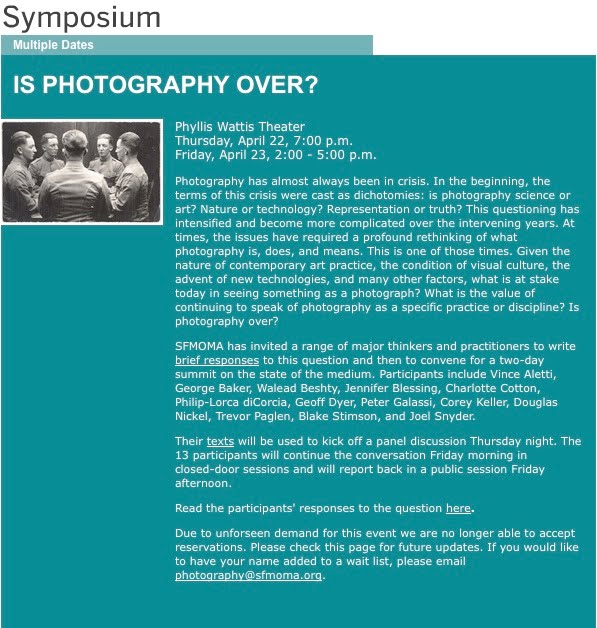
San Francisco Museum of Art is hosting a provocative seminar titled "Is Photography Over?". They've assembled an impressive roster of panelists to debate the topic. You can read more about it here:

I mention it here - fully aware that most of us won't be able to go - because of the wise format of the seminar. The topic question has been asked in advance to all of the participants, and their answers are posted online here. It's one of the pithiest collections of photographically themed essays I've read in a long time. Highly recommended. None of them are more than a few paragraphs, and a few are gems. Check it out.
Houston Fotofest report coming soon.....
I mention it here - fully aware that most of us won't be able to go - because of the wise format of the seminar. The topic question has been asked in advance to all of the participants, and their answers are posted online here. It's one of the pithiest collections of photographically themed essays I've read in a long time. Highly recommended. None of them are more than a few paragraphs, and a few are gems. Check it out.
Houston Fotofest report coming soon.....
Friday, March 19, 2010
Evan's AIPAD Overview.
Better too late than never is an aphorism I've always enjoyed, so here now, too late, are my first impressions of the 2010 edition of the AIPAD show. Perhaps those of you heading to the fair on the weekend will get some benefit from the overview, though I suspect most of my readers have already been at least once and made their own first impressions.
Attendance seems good and the energy was high in the first days. Even during work hours on Thursday and Friday, the aisles were never empty. AIPAD is not the place to find the most cutting edge work in the field, but I was happy to see a few examples of forward thinking art. For example, Stephen Bulger from Toronto was doing brisk business with Alison Rossiter's "lament" series. Ms Rossiter has been working with expired photo paper in a variety of ways over the last few years exploring the material's rich surface as well as damage that has accrued to the paper. Some pieces chart only the damage as she prints the unexposed paper revealing scars from mold, light, and handling. Other paper is put into contact directly with developer chemical by dipping or pouring. The result is a remarkable "photogram" that is achieved without the use of light communicating sadness at the loss of photographic materials that is quite poignant.

On the classic front, there are many more superb examples to illustrate. Charles Schwartz can always be counted on to bring an array of stunning 19th century work. In addition to some intriguing Orientalia, his pride of place went to a fine example of Robert Howlett's portrait of a ship owner from 1857. Another amazing example is at the Met as part of the Gilman Paper Collection.
[Isambard Kingdom Brunel Standing Before the Launching Chains of the Great Eastern]
Robert Howlett (English, 1831–1858)
The Weston Gallery had a marvelous anonymous diptych featuring a cyanotype photogram of a pair of ferns paired with the actual botanical examples used to make the print. I have no idea how these fragile little plants have survived 180 years, but here they are for us to see:

Gary Edwards brought another set of brilliant hand-tinted tintypes and salt prints. Featured were a set of soldiers and another set of African-American portraits. Gorgeous, subtle, and rare. Take a close look.
Moving forward in history a bit, Charles Isaacs had praiseworthy photos both on his walls and in his bins. On the walls, one is treated to a Brancusi portrait of his own iconic scupture, Bird in Space. Though conservation has been done to this print, it's still a stunning object. Details and provenance below:

 In the bins and available upon request are a deceptively modern Pompeii study attributed to Giorgio Sommer, William Larson fax pieces and figure studies, and a Nathan Lerner study in light on paper titled, "Car Light Study #7". It's a vintage silver print from 1939. Lerner (1913-1999) was one of the original students at the New Bauhaus in Chicago, and later became the Head of the Photography Department at the School of Design, and then Dean of Faculty and Students. If you're interested in Chicago School work, ask Chuck to bring it out.
Continuing our march up the photo history timeline, Hemphill Gallery has a wall of vintage William Christenberry Kodak Brownie color landscapes, L. Parker Stephenson has a fun Umbo photogram of stockings (as well as my friend Raphael Dallaporta's Antipersonnel series),
 And Paul Hertzmann had a lovely 1935 solarized nude by Osamu Shiiara.
Steven Kasher's booth was full of unexpected pleasures and treasures. Top on my list was a collection of hand-tinted, vernacular portraits of African-Americans from the 60s. Vernacular may be an erroneous term here since the pictures show a sure professional hand, so perhaps anonymous is a more apt description. In any case, I loved their quirky flavor:

Deborah Bell always delivers with great examples from still-under-appreciated Gerard P. Fieret. If I had the cash, I would buy a box of them. I'm confused why they don't catch on:


Laurence Miller also was pitching to my wheelhouse with a striking example of a nude composite from my perennial favorite, Ray K. Metzker along with a wall vintage Helen Levitt that deserves close attention.
 Also in Miller's booth were film strip explorations by Barbara Blondeau. Blondeau died young and left us little work to admire, but what she accomplished shows that she would have been a keen contributor to the Chicago legacy along with her Philadelphia compatriots Ray Metzker and William Larson. Sorry for the particularly crappy jpeg:

I was helping Tom Gitterman in his booth this year, so I can't say I'm neutral, but I'm a big fan of his selection of both Kenneth Josephson and Ferenc Berko. There are prime examples on the walls and in the bins.
Last, and not least, is the booth for AXA art insurance. While they were not intentionally displaying artwork, the examples they brought of burned and destroyed art was sublime and beautiful perhaps above anything else I saw at the fair. If you put a wall label of an established artist like Thomas Zipp under either of these works, you could have sold them at last week's Armory fair for high 5 figures. Take a look when you pass by:

 More to come. Comments welcome and encouraged......
Attendance seems good and the energy was high in the first days. Even during work hours on Thursday and Friday, the aisles were never empty. AIPAD is not the place to find the most cutting edge work in the field, but I was happy to see a few examples of forward thinking art. For example, Stephen Bulger from Toronto was doing brisk business with Alison Rossiter's "lament" series. Ms Rossiter has been working with expired photo paper in a variety of ways over the last few years exploring the material's rich surface as well as damage that has accrued to the paper. Some pieces chart only the damage as she prints the unexposed paper revealing scars from mold, light, and handling. Other paper is put into contact directly with developer chemical by dipping or pouring. The result is a remarkable "photogram" that is achieved without the use of light communicating sadness at the loss of photographic materials that is quite poignant.

On the classic front, there are many more superb examples to illustrate. Charles Schwartz can always be counted on to bring an array of stunning 19th century work. In addition to some intriguing Orientalia, his pride of place went to a fine example of Robert Howlett's portrait of a ship owner from 1857. Another amazing example is at the Met as part of the Gilman Paper Collection.
|

Robert Howlett (English, 1831–1858)
The Weston Gallery had a marvelous anonymous diptych featuring a cyanotype photogram of a pair of ferns paired with the actual botanical examples used to make the print. I have no idea how these fragile little plants have survived 180 years, but here they are for us to see:

Gary Edwards brought another set of brilliant hand-tinted tintypes and salt prints. Featured were a set of soldiers and another set of African-American portraits. Gorgeous, subtle, and rare. Take a close look.
Moving forward in history a bit, Charles Isaacs had praiseworthy photos both on his walls and in his bins. On the walls, one is treated to a Brancusi portrait of his own iconic scupture, Bird in Space. Though conservation has been done to this print, it's still a stunning object. Details and provenance below:

Constantin Brancusi: Bird in Space. Vintage silver print, 11-1/4 x 8-9/16 in. (287 x 218 mm), c. 1930/1945, unmounted. w1589. Gift of the artist to the photographer Bernhard Moosbrugger in 1955, when he and journalist Gladys Weigner made eight visits to the artist.
Also in the booth at Isaacs' is a solarized nude by Blanc & Demilly. It's already sold, so take a look before it disappears:

Continuing our march up the photo history timeline, Hemphill Gallery has a wall of vintage William Christenberry Kodak Brownie color landscapes, L. Parker Stephenson has a fun Umbo photogram of stockings (as well as my friend Raphael Dallaporta's Antipersonnel series),

Steven Kasher's booth was full of unexpected pleasures and treasures. Top on my list was a collection of hand-tinted, vernacular portraits of African-Americans from the 60s. Vernacular may be an erroneous term here since the pictures show a sure professional hand, so perhaps anonymous is a more apt description. In any case, I loved their quirky flavor:

Deborah Bell always delivers with great examples from still-under-appreciated Gerard P. Fieret. If I had the cash, I would buy a box of them. I'm confused why they don't catch on:


Laurence Miller also was pitching to my wheelhouse with a striking example of a nude composite from my perennial favorite, Ray K. Metzker along with a wall vintage Helen Levitt that deserves close attention.


I was helping Tom Gitterman in his booth this year, so I can't say I'm neutral, but I'm a big fan of his selection of both Kenneth Josephson and Ferenc Berko. There are prime examples on the walls and in the bins.
Last, and not least, is the booth for AXA art insurance. While they were not intentionally displaying artwork, the examples they brought of burned and destroyed art was sublime and beautiful perhaps above anything else I saw at the fair. If you put a wall label of an established artist like Thomas Zipp under either of these works, you could have sold them at last week's Armory fair for high 5 figures. Take a look when you pass by:


Tuesday, March 16, 2010
A plug for my own event
Here's a quick notice about an interview I'll be doing at the NYPL this Saturday. I thought I'd post it before the madness of AIPAD starts. I'll be busy with dispatches from the fairs over the next few days, so I wanted to be sure I let everyone know about this which I copy from a NYPL press release:
Initiated in 2004, the Artist Dialogues provide a forum for understanding and appreciation of contemporary art. Artists are paired with critics, curators, writers or other artists to converse about art and the potential of new ideas.
M i d - M a n h a t t a n L i b r a r y
presents
An Artist Dialogue Series Event
Christian Erroi and Evan Mirapaul
Saturday March 20, 2010
2:30 p.m. on the 6th floor
Mid-Manhattan Library
The New York Public Library
40th Street and 5th Avenue
New York , NY 10016
212-340-0871
Elevators access the 6th floor after 2p.m.
All events are FREE and subject to last minute change or cancellation.
Evan Mirapaul, contemporary art collector, will join artist Christian Erroi to talk about art and life and to discuss his site-specific Art in the Windows exhibition Leads and Traces .
Christian Erroi is a photographer who lives and works in New York . His wellsprings of inspiration have long been from nature and introspection about his own physiological studies. Since 2001, his personal work has ranged from abstracted landscapes to calligraphic figure studies. He studied at the International Center of Photography in New York. His work was selected for two Art + Commerce Festivals of Emerging Photographers. In 2008, he had his first solo exhibition in the United States, at Poissant Gallery in Houston, as part of Houston Fotofest. He has exhibited his work in numerous group shows in the U.S. and Europe, and also in several solo exhibitions in Switzerland. In 2009 he was a featured artist in the LiShui Photo Festival in China . His work is held in many private collections worldwide, and in the collection of Museum of Modern Art , New York; the George Eastman House, Rochester, New York; the Museo Cantonale di Lugano and the Musee de l'Elysee, Lausanne, Switzerland.
Subscribe to:
Posts (Atom)